 Ray
Ray
Ray buybacks use pool trading fees to repurchase Raydium's RAY token
Ray buybacks use a 12% share of trading fees from Raydium's standard AMM v4, CPMM and CLMM pools to repurchase RAY. RAY is Raydium's native token on Solana, and the repurchased tokens remain in protocol holdings. The percentage applies to fees that swaps generate; it does not take 12% of the traded amount. Liquidity providers earn a separate fee share. The fee rate and trading activity determine the allocation, while purchase prices determine the number of RAY tokens acquired. Accrued fees, completed purchases and a holding balance measure different parts of this flow.
In short: A pool's buyback allocation measures fee funding, while the RAY actually acquired depends on completed conversions and their execution prices.
Trading Activity and the Buyback Budget
The amount allocated to buybacks increases when eligible pools collect more trading fees, assuming the 12% share remains unchanged. Trading volume contributes through the fee that each pool charges. Higher volume at the same fee rate creates a larger fee base. Different fee rates can produce different allocations from equal trading volume.
Fee revenue therefore gives a closer starting point than volume alone. The relationship is trading fees multiplied by the applicable buyback share. Across pools, that calculation must preserve each pool's actual fee settings. A large volume figure cannot establish how much RAY the protocol purchased, because collection and conversion occur further along the flow.
Fee Allocation Across Pool Designs
CLMM and CPMM use a published trading-fee split of 84% for liquidity providers, 12% for buybacks and 4% for treasury funding. CPMM means constant-product market maker. CLMM means concentrated liquidity market maker, where liquidity occupies selected price ranges. These designs account for LP earnings differently while keeping the same published allocation percentages.
CPMM and CLMM Fee Destinations
The pool program divides the trading fee into portions with separate recipients. An LP's position represents a claim on its eligible liquidity earnings; it does not give that LP the protocol's entire fee collection.
Liquidity Provider Earnings
The LP share compensates liquidity that supports swaps. CPMM retains that portion in pool reserves. CLMM accounts for earnings through active liquidity and individual positions.
Buyback And Treasury Allocations
The buyback portion funds RAY accumulation, while the treasury portion has its own destination. In program accounting, these appear as protocol and fund fees. Combining both portions would overstate the trading-fee allocation assigned to buybacks.
Standard AMM v4 and Stable AMM
Standard AMM v4 allocates 88% of its usual trading fee to LPs and 12% to the protocol buyback share. Its standard swap fee is 0.25%. Early pools can have different stored parameters, so that standard does not establish every historical pool's settings. Stable AMM also uses an 88% LP and 12% protocol split, with a documented 0.02% trading fee. Neither fee model includes the separate fund portion used by CPMM and CLMM.
Collection Before RAY Purchases
Pool programs accrue protocol fees before collection moves those tokens into the wider buyback flow. Accrued means earned and recorded, even when the tokens have not yet left their pool vault. A successful swap can increase a protocol fee balance without completing a RAY purchase.
CPMM and CLMM maintain protocol fee counters apart from their LP accounting. Authorized collection instructions withdraw those accrued amounts. Standard AMM v4 uses its protocol profit counters and an administrative withdrawal instruction. These mechanisms identify fees available for collection, not a fixed purchase schedule.
Program-specific collection addresses can hold several assets because pools earn fees in the tokens that they trade. A collected balance may require conversion before it becomes purchased RAY. The fee token and the final holding token therefore have different roles, even though both belong to the same funding flow.
Conversion spends collected assets to acquire RAY. The allocation percentage determines the fee portion assigned to that purpose. It does not determine the exchange rate, resulting token count or delay between accrual and purchase.
An accrued balance measures outstanding fees. A completed purchase measures an executed exchange. The holding balance measures tokens present after incoming and outgoing movements. Adding these figures together can count the same value at successive stages, so a buyback total needs a clearly defined stage and reporting period.
A Hypothetical Trading Fee Allocation
Consider a hypothetical CPMM fee total of 1,238 units of one fee token. This example uses the published 84% LP, 12% buyback and 4% treasury split. The starting total is illustrative, not a live pool balance.
Multiplying 1,238 by 12% gives 148.56 fee-token units assigned to buybacks. The LP portion is 1,039.92 units, and the treasury portion is 49.52 units. Those allocations sum to the original 1,238 units. The 148.56 figure represents the funding portion, not 148.56 RAY acquired.
The comparison with standard AMM v4 isolates the different recipient split. Under its usual 88% LP and 12% buyback allocation, the same hypothetical fee total gives LPs 1,089.44 units. The buyback portion remains 148.56 units, with no separate fund allocation in that trading-fee model.
A larger or smaller fee total changes each allocation proportionally while those shares remain unchanged. The eventual RAY amount also depends on conversion prices. This arithmetic describes fee allocation before token-precision rounding, conversion costs or completed purchase accounting.
Purchase Prices and the RAY Token Count
A buyback budget acquires fewer RAY tokens at a higher average execution price and more at a lower price. For a completed purchase, dividing the amount spent by its average purchase price gives the token quantity, provided both use the same payment unit. Allocated fees alone cannot supply that price.
Price impact describes how an order changes its execution price as it consumes available liquidity. Buyback conversions executed through pools face that same relationship. The relevant purchase amount is the RAY actually received. A later market valuation of those holdings answers a different question from the historical amount spent.
Does a RAY Buyback Permanently Reduce Token Supply?
A RAY buyback transfers purchased tokens into protocol holdings without permanently destroying them. Raydium holds repurchased RAY at a public on-chain address. A token burn reduces the mint's supply through a different operation. A transfer into protocol holdings does not establish such a burn.
Total supply and circulating supply also measure different things. Total supply counts existing tokens. Circulating-supply figures depend on which holdings the calculation includes. A protocol holding balance alone cannot establish a matching decline in circulating supply, particularly when other allocations or reward distributions move during the same period.
Buybacks Alongside LP Earnings and Staking
Buybacks fund protocol RAY holdings, while pool earnings and direct RAY staking reward their respective eligible positions. CPMM and standard AMM v4 incorporate LP fees into reserves that LP tokens represent. CLMM positions accrue fees under their range rules. Direct staking distributes RAY rewards through its own program. Holding RAY does not turn the protocol's buyback allocation into a personal fee payment, and a buyback percentage does not express the yield of a stake or liquidity position.
Public Balances and Completed Buyback Totals
Public transaction history separates fee collection, conversion activity and transfers into protocol RAY holdings. Collection balances can include unconverted fees. A holding balance reflects token movements, so it does not necessarily equal cumulative purchases. Repeated transfers of the same RAY must not become repeated purchases in a report. Token identities, transaction amounts and the reporting period establish what each movement represents. Fees allocated, RAY purchased and net accumulation need separate labels because they measure different states.
Separate Charges and Creator Revenue
The 12% trading-fee share does not apply automatically to every cost associated with Raydium activity. Solana network fees pay for transaction processing. Account rent funds storage, and pool creation charges follow their own protocol collection path. Those charges have different bases and destinations from the fee split that a pool applies to swaps.
Token-2022 is Solana's token program with optional extensions, including transfer fees. When an asset uses that extension, its mint-level fee remains separate from Raydium's pool trading fee. Applying the buyback percentage to the combined cost would misclassify that charge.
CPMM can also charge an optional creator fee separately from the trading fee. Since the September 19, 2026 upgrade, a configured portion of accrued creator fees can enter the protocol fee counter at collection. The share depends on the applicable configuration, including any creator-specific override. That additional accrual does not change the published 12% trading-fee component into a percentage of all protocol receipts.
LaunchLab Fees Before and After Graduation
LaunchLab's bonding-curve phase uses launch-specific fee accounting before graduation moves trading into a pool. A bonding curve prices a launched token through a programmed relationship between reserves and trading. Its protocol and creator fee settings belong to that launch phase. The pool buyback split cannot simply be applied to every bonding-curve charge.
Graduation moves new launches into CPMM, where trading fees follow the destination pool's configuration. Optional CPMM creator fees remain separate. Legacy launches configured for AMM v4 can still migrate there; subsequent swaps use its fee model. A launch-related fee total that spans both phases must distinguish the bonding-curve portion from subsequent pool trading. The name of the launched token does not establish which fee rules applied to an individual transaction.
Fee Configuration and Market Outcomes
CPMM fee rates can change through administrative configuration updates, affecting subsequent swaps in pools attached to that configuration. The pool's effective settings therefore qualify the published fee model. CLMM pools with dynamic fees add a volatility-based surcharge to their base rate. The applicable percentage acts on the fee actually generated.
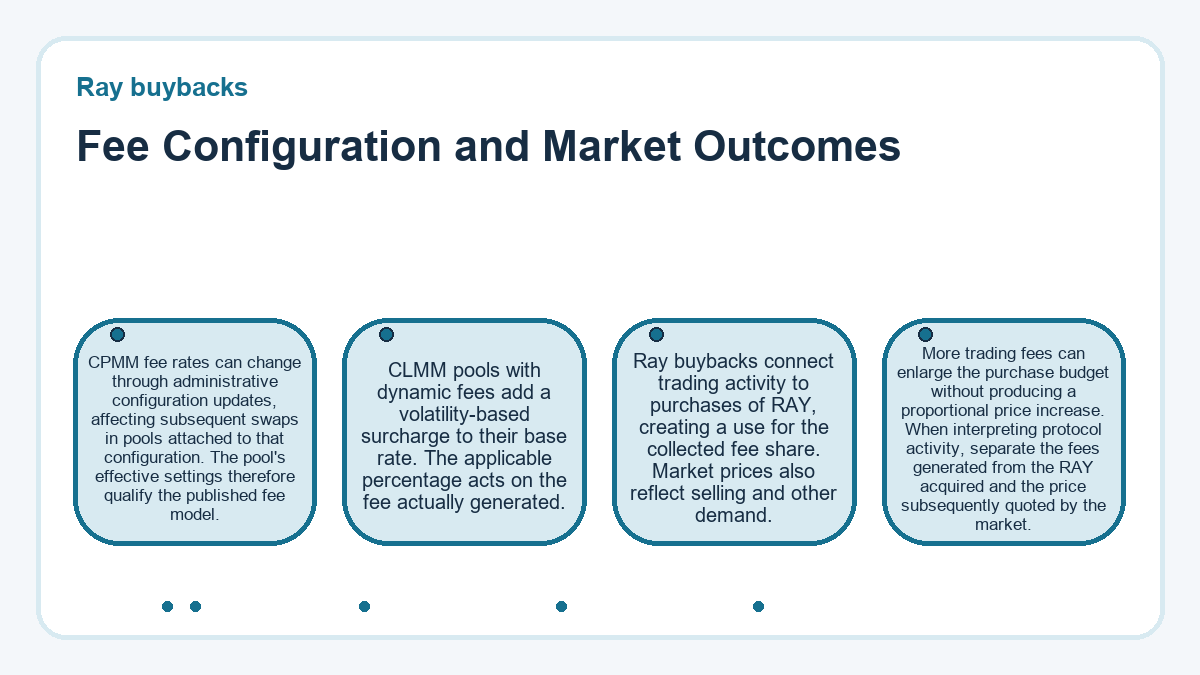
Ray buybacks connect trading activity to purchases of RAY, creating a use for the collected fee share. Market prices also reflect selling and other demand. More trading fees can enlarge the purchase budget without producing a proportional price increase. When interpreting protocol activity, separate the fees generated from the RAY acquired and the price subsequently quoted by the market.
Questions people ask about Ray buybacks
Do Swaps Routed Through Another Interface Still Fund RAY Buybacks?
Swaps that execute in an eligible Raydium pool incur that pool's trading fee regardless of the interface that submitted them. Raydium's AMM Routing program charges no separate router fee; each pool along its route applies its own fee rules. Any additional interface charge requires separate accounting and cannot automatically be counted as buyback funding.
Which Token Pays the Buyback Share When a Swap Sells RAY?
The buyback share accrues in the token that the pool uses to charge its trading fee. CPMM and standard AMM v4 charge their trading fee on the input, so a direct RAY sale accrues that fee in RAY. CLMM normally uses the input token, although customizable pools can fix fee collection to one side, including the output for the opposite trading direction.
Why Can Small CPMM Swaps Deviate Slightly From the Advertised Fee Split?
CPMM calculates fees in integer token units, which introduces rounding at small amounts. Its protocol and fund portions round down when calculated from the trading fee, and the LP portion receives the remainder. Advertised percentages describe the allocation rates; the smallest transferable units constrain the amounts that one swap can actually assign.
Does Collecting CPMM Protocol Fees Move the Pool Price?
Collecting accrued CPMM protocol fees preserves the pool's effective reserves because its pricing calculation already excludes those amounts. Collection removes the tokens and reduces the corresponding counters by the amounts collected. A RAY purchase funded afterward is a separate market operation whose own execution can affect prices; moving an accrued fee balance alone does not perform that purchase.
Are Perpetual Funding Payments Part of the Pool Buyback Budget?
Perpetual funding payments transfer value between long and short traders, so they are outside the pool trading-fee allocation. Raydium Perps uses Orderly Network's funding mechanism. Funding costs affect a trading position, but they do not represent the AMM pool fees to which the published 12% buyback split applies.
How Are Fees From Different Tokens Combined in a Buyback Report?
Fees denominated in different tokens need a common valuation unit before their values can be added. The report must use a stated valuation time or the actual conversion proceeds, depending on what it measures. Summing raw token quantities mixes unlike units. Converting those values does not establish the RAY amount received without the completed purchase data.
Do Historical OpenBook Profit Counters Show New Buyback Funding?
AMM v4's retired OpenBook profit counters retain historical values and no longer record new order-book activity. The active AMM swap-fee path continues to accrue its protocol portion separately. A historical profit counter should therefore not be treated as a current buyback inflow or combined with present swap-fee accrual as though both remain active.